
Slipped Disc (Lumbar Disc Herniation)
Herniated lumbar disc with leg pain: the honest version of what it actually takes to recover, and when physio is (and isn't) enough.
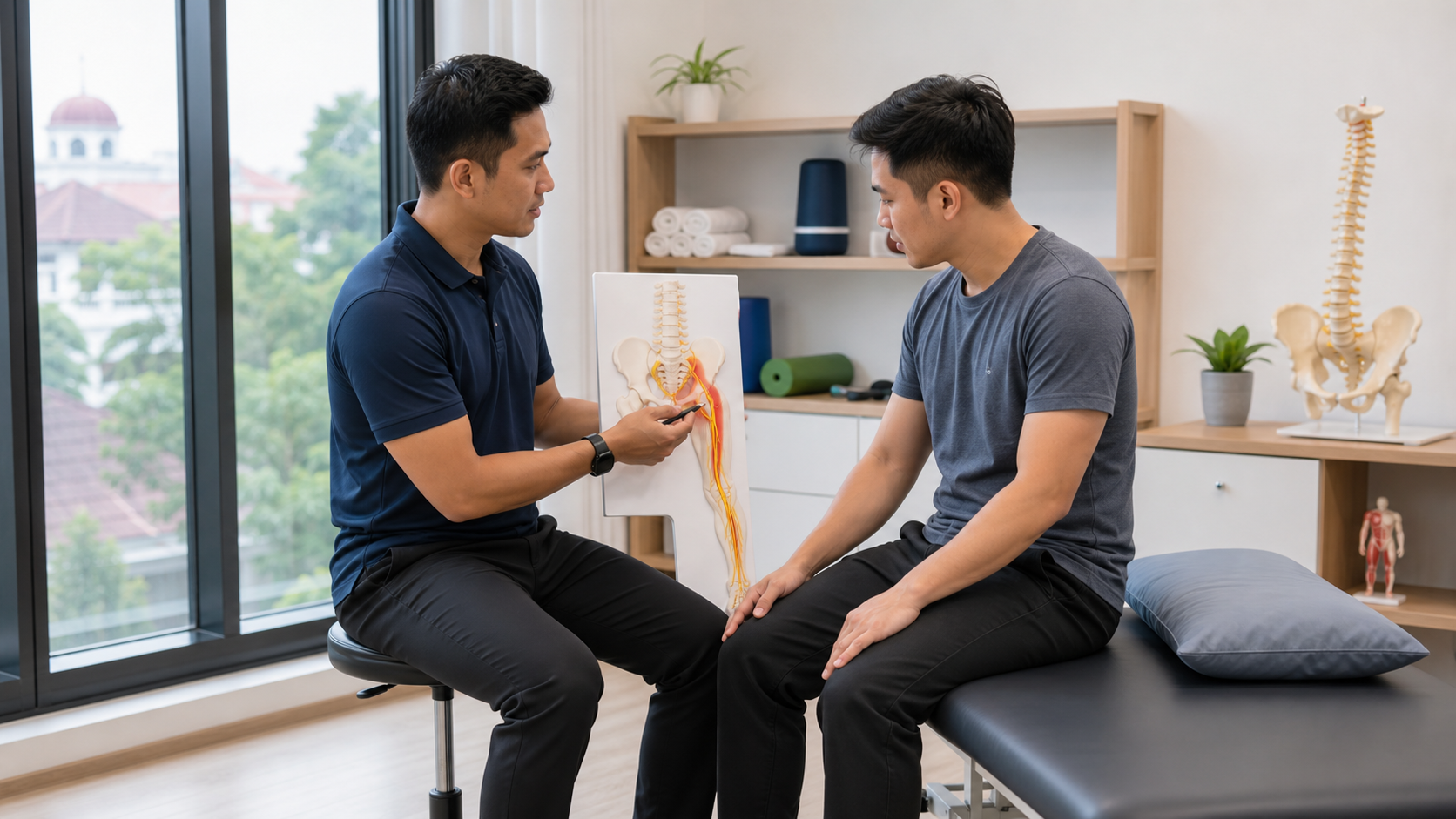
A slipped disc (lumbar disc herniation, or 腰椎间盘突出 in Mandarin) is when the softer centre of a spinal disc pushes out through the tougher outer ring and presses on a nerve root: usually the sciatic nerve.
It causes the classic picture: low back pain that shoots into a buttock, down the back of the leg, sometimes past the knee, with pins-and-needles or weakness in the foot.
Most Seremban and Nilai patients get this diagnosis after an MRI at KPJ Seremban Specialist Hospital, Columbia Asia Seremban, or NSCMH Medical Centre when conservative treatment hasn't worked fast enough.
The honest reality: most slipped discs get better without surgery, even when the MRI looks dramatic.
The picture of the disc doesn't match the strength of the symptoms; many people with visible disc bulges have no pain at all.
We match you on WhatsApp to a physio in Seremban or Nilai whose caseload regularly includes confirmed disc cases, not just generic low back pain.
Daily Seremban–KL commuters and Senawang shift-workers make up a steady share of these referrals.
How to tell if it's really a slipped disc
A true symptomatic slipped disc usually involves all three of:
- Back pain with leg pain that follows a nerve pattern (shoots down a buttock, thigh, calf, or foot: the saraf tepi tersepit pattern)
- A positive clinical nerve-tension test (straight-leg raise, slump test)
- Sometimes numbness, pins-and-needles, or mild weakness in a specific dermatome / myotome
MRI findings without these clinical signs are often incidental: a disc bulge on imaging is common in people over 30 who have no pain at all.
A good physio correlates your symptoms with the scan, not the other way around. Typical lumbar levels: L4–L5 and L5–S1.
Less commonly, cervical disc herniation causes arm pain and weakness: same logic applies.
Cases often come through Hospital Tuanku Ja'afar orthopaedic clinic, a KPJ specialist, or an older workplace-injury insurance-covered road-accident claim. The MOH Clinical Practice Guideline recommends a trial of conservative care before surgical referral unless red flags are present.
What a first slipped-disc physio session looks like
First session 45–60 minutes, RM 80–150 in a Seremban or Nilai private clinic.
Bring the MRI report and any referral letter from Hospital Tuanku Ja'afar or a private specialist: the physio needs to know which level is involved and whether there's stenosis as well.
Expect three parts: a symptom map (pain drawing, trigger positions, what worsens it), a nerve-tension assessment and neurological screen (reflexes, power, sensation), and an initial plan.
The evidence-based backbone is usually directional-preference work (often extension or McKenzie-style in flexion-dominant presentations), nerve gliding exercises, graded walking, and progressive strength work.
Manual therapy is adjunct, not the main treatment.
A good physio will say upfront: 'If in two weeks the leg pain hasn't eased, we'll escalate: imaging review, spinal pain management, or surgical consult.' That honesty matters more than the specific modalities used.
Typical slipped-disc recovery timeline
Broad ranges Seremban and Nilai physios set with patients:
- First 2 weeks: worst leg pain usually starts easing, especially with the right directional-preference work.
Pain medication often needed alongside: arranged by a GP or specialist, not the physio - Weeks 2–6: 8–12 physio sessions across this window; nerve symptoms (pins-and-needles, leg pain) should be receding even if back pain lingers - Weeks 6–12: strength work ramps up; most patients back to regular work - Months 3–6: most uncomplicated disc cases have recovered; recurrence prevention is the focus - Months 6–12: residual low-grade back stiffness can persist but is usually manageable with a maintenance programme
Surgery rates for slipped disc at KPJ Seremban Specialist Hospital and similar hospitals are low as a percentage of all cases: most resolve conservatively.
The physio should be re-assessing every 3–4 sessions on objective markers: how far the pain travels down the leg, strength tests, straight-leg raise distance, and function (how long you can sit, drive, or stand).
Physio first or specialist first?
Physio first is reasonable if:
- Leg pain is annoying but not severe, and you can still walk, sit, and sleep most nights
- No red-flag symptoms (see below)
- You've never been imaged or the MRI shows a straightforward herniation without severe nerve-root compression
Go straight to A&E at Hospital Tuanku Ja'afar if any of these appear: sudden numbness in the saddle region (groin and inner thighs), new loss of bladder or bowel control, progressive leg weakness (foot drop, can't stand on tiptoes, can't push against resistance), severe unrelenting pain that's worse lying down and wakes you every night, or fever alongside back pain.
These are the cauda equina and infective red flags: time-critical and not a physio case. See a spinal surgeon first if you already have a 6+ week course of physio behind you without improvement.
📍 Find slipped disc (lumbar disc herniation) physio near you →
Questions people ask
- Can physio actually fix a slipped disc, or just manage the pain?
- Physio doesn't push the disc back in: nothing short of surgery does that. What physio does is reduce the inflammation around the nerve, restore movement, and strengthen the surrounding muscles so the pain settles and stays settled. For most people, that's all they need: the disc may still look the same on MRI, but the symptoms are gone.
- Will I definitely need surgery if the MRI shows a large herniation?
- No. The size of the herniation on MRI doesn't predict who needs surgery: the clinical picture does. Large herniations often heal and shrink over 6–12 months. Surgery is considered only when there's progressive weakness, cauda equina signs, or 3–6 months of conservative care has failed.
- I've already been to a chiropractor: can I still benefit from physio?
- Yes, and the two can complement each other when the clinical picture is right. However, high-velocity manipulation isn't advised in acute disc cases with nerve-root symptoms; a physio's approach (exercise-led, graded) tends to be safer for the disc-herniation pattern specifically.
- How much does a full slipped-disc course of physio cost in Seremban?
- Typically 8–16 sessions at RM 80–150 each, so RM 640–2400 for a course. Private medical insurance often covers part of this if there's a diagnosis code and specialist referral. workplace-injury insurance covers post-road-accident cases on the approved panel.
- Can I WhatsApp you my MRI to check if a clinic is the right fit?
- Yes. WhatsApp us the MRI report (the written impression is enough: no need for images), your main symptoms, and your postcode. We'll suggest which Seremban or Nilai physio has regular disc caseload and fits your location.
Not sure which physio fits your case?
Message us on WhatsApp with your condition and area: we'll suggest a physio in Seremban or Nilai that matches.