
Sciatica
Shooting leg pain from the lower back: what it actually is, what makes it worse for commuters and shift-workers, and how Seremban physios treat it.
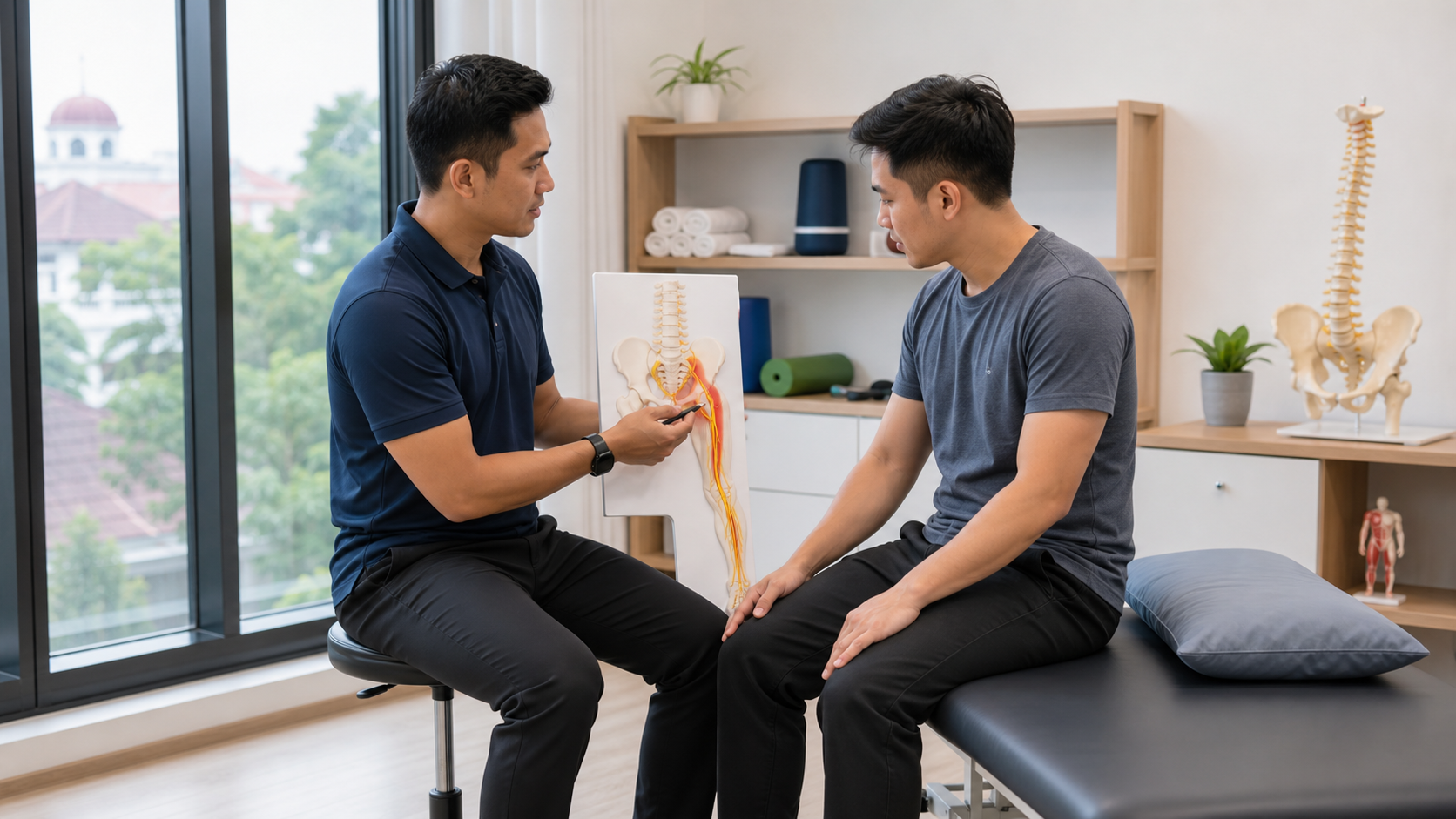
Sciatica (saraf tepi tersepit locally, or 坐骨神经痛 in Mandarin) is not a diagnosis on its own: it's a symptom of a nerve being compressed somewhere along its path from the lower spine to the foot.
The classic presentation is pain that starts in the buttock and shoots down the back of the thigh, sometimes past the knee into the calf or foot, often with pins-and-needles, occasionally with weakness.
It can come from a slipped disc, piriformis tightness, spinal stenosis, spondylolisthesis, or less often a direct nerve irritation.
In Seremban and Nilai we see it every week in daily Seremban–KL commuters who do long drives on the PLUS Highway, Senawang shift-workers standing twelve hours, warehouse workers at Nilai 3 Inland Port, and older patients from Port Dickson and Seremban Chinatown with spinal stenosis.
We match you on WhatsApp to a physio whose caseload specifically includes sciatica pattern-work, not just generic low back pain.
What's actually causing your sciatica
Knowing the cause matters because the plan is different for each:
- Disc herniation (most common in adults 25–55): younger, sudden onset, often after a lift or prolonged sitting; responds to directional-preference exercises
- Spinal stenosis (common 55+): gradual onset, pain worse with standing and walking, eased by sitting or bending forward; common in Port Dickson retirees and Seremban Chinatown seniors
- Piriformis-related nerve irritation (less common): pain worse with sitting on the buttock, not a clear dermatome; responds to hip stretching and strengthening
- Spondylolisthesis: vertebra slipped forward, slower onset, often felt through a nerve-level pattern
- Pregnancy: hormonal ligament laxity plus weight shift; usually self-limiting, physio helps the flare
- Post-road-accident (workplace-injury insurance): direct or referred nerve irritation from a traumatic event
A good Seremban or Nilai physio maps the cause clinically (straight-leg raise, slump test, dermatome, reflexes, strength) before assuming it's a disc.
Imaging at KPJ Seremban Specialist Hospital, Columbia Asia Seremban or Hospital Tuanku Ja'afar is reserved for when red flags appear or conservative treatment stalls.
What a first sciatica session looks like
First session 45–60 minutes, RM 80–150 in a Seremban or Nilai private clinic. Panel-clinic rates under workplace-injury insurance are lower; private medical insurance often covers part with a referral.
Expect: a pain map (draw where the pain is and where it shoots); positional testing (does it worsen standing, sitting, bending?); nerve-tension tests (straight-leg raise, slump); neurological screen (reflexes, power, sensation); and a plan with 2–4 home exercises.
The physio will usually set a clear directional preference: exercises that reduce leg pain are in; exercises that increase it are out.
A good physio is also honest about modalities: electrotherapy, ultrasound and heat can soothe but don't drive recovery: the real work is movement, nerve gliding, targeted strength, and work modification.
Expect them to re-test at sessions 3–4 and escalate if the leg pain hasn't retreated up the leg (centralisation) by then.
Typical recovery timeline
Most sciatica settles within 6–12 weeks of the right physio approach. Broad ranges:
- First 1–2 weeks: leg pain should start retreating up the leg (from foot → calf → thigh → buttock).
This 'centralisation' is the strongest single predictor of recovery - Weeks 2–6: 6–10 physio sessions, strength and nerve gliding work, slow return to full work hours (especially for long drivers on the PLUS Highway who can't sit a full day yet) - Weeks 6–12: most cases resolved or near-resolved; residual back stiffness can linger - Months 3–6: recurrence-prevention exercises become the focus: core, hip, and hamstring work - Beyond 6 months: if pain persists and a 6–8 week physio block hasn't moved the needle, imaging review and specialist consult are warranted
Recurrence is common without a maintenance programme: a 10-minute daily routine does more for ongoing prevention than occasional clinic visits.
Physio first or hospital first?
Physio is reasonable first step if:
- Leg pain is annoying but not severe; you can still walk, sit, and sleep
- No red-flag symptoms
- You don't have progressive weakness or numbness
Go to A&E at Hospital Tuanku Ja'afar, not a physio, if any of these appear: sudden numbness in the saddle region (groin, inner thighs, anus), new loss of bladder or bowel control, progressive leg weakness (foot drop, inability to stand on tiptoes), severe unrelenting pain that wakes you every night even lying still, or fever alongside back and leg pain.
These are cauda equina and infective warning signs: time-critical and not physio cases.
See a specialist before physio if you've already had 6+ weeks of physio elsewhere with no centralisation: imaging and possibly a spinal pain management consult at a private hospital like KPJ Seremban Specialist Hospital or Columbia Asia Seremban may be the missing piece.
📍 Find sciatica physio near you →
Questions people ask
- Is sciatica the same as a slipped disc?
- No. Sciatica is a symptom: leg pain from nerve compression. A slipped disc is one possible cause. Stenosis, piriformis issues, spondylolisthesis, and others can also cause the same leg pain pattern. A good physio works out which before setting a plan.
- How much does sciatica physio cost in Seremban and Nilai?
- First visit RM 80–150 for 45–60 minutes; follow-ups RM 60–120. Most patients need 6–12 sessions. workplace-injury insurance panel-clinic rates are lower; private medical insurance often covers part with a referral and diagnosis code.
- Can I exercise through sciatica or will I make it worse?
- The right exercises help; the wrong ones make it worse. That's why a physio's first job is to establish a directional preference: movements that reduce leg pain are safe to repeat, those that aggravate are off-limits this week. Never self-prescribe internet stretches for sciatica.
- My doctor says I have stenosis: can physio still help?
- Yes. Stenosis usually responds to flexion-biased work (knees-to-chest, bike over treadmill) and graded walking with rest stops. Many Port Dickson retirees and Seremban Chinatown seniors with stenosis keep functional lives for years with a good maintenance programme.
- I had a road accident: should physio happen before or after workplace-injury insurance approval?
- Initial urgent physio often starts before full workplace-injury insurance processing when the case is time-critical. Keep every medical certificate, MRI and specialist note for the claim. WhatsApp us and we'll flag which Seremban or Nilai clinics are on the workplace-injury insurance panel.
Not sure which physio fits your case?
Message us on WhatsApp with your condition and area: we'll suggest a physio in Seremban or Nilai that matches.