
Neck Pain
Stiff, achy or shooting neck pain: what desk work at Sendayan TechValley, long PLUS Highway drives, and bad pillows actually do to the cervical spine.
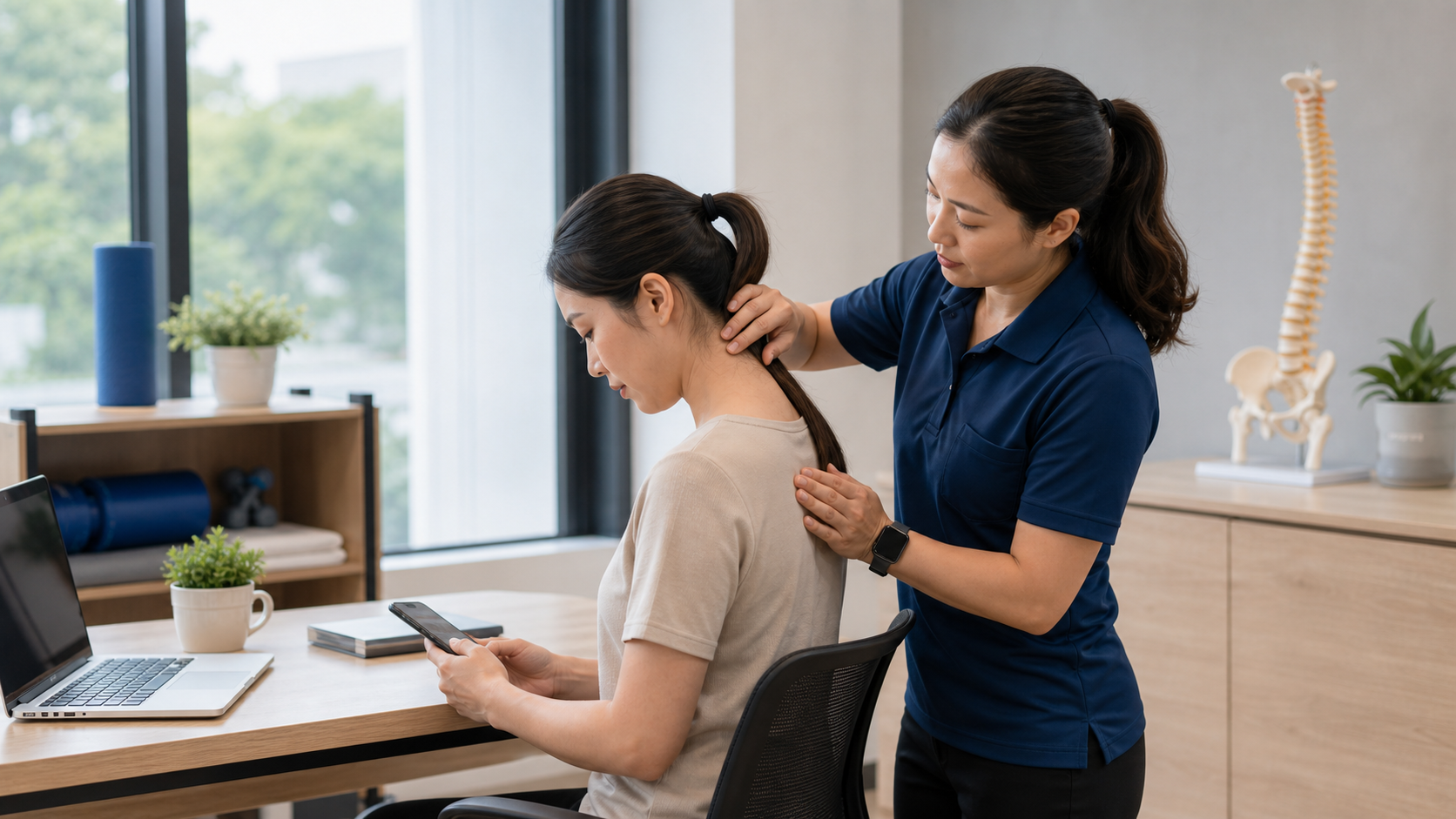
Neck pain is the second most common MSK complaint walking into Seremban and Nilai physio clinics: right behind low back pain.
It shows up in daily Seremban–KL commuters on the PLUS Highway, Senawang shift-workers bent over production lines, office staff at Sendayan TechValley and Nilai 3 wholesale offices, Nilai university students hunched over laptops, and KLIA logistics staff.
The classic pattern is a stiff, achy neck that's worst in the morning or by the end of the workday, sometimes with a tension-pattern headache, sometimes with shoulder or arm pain.
We match you on WhatsApp to a Seremban or Nilai physio whose caseload already has this exact presentation.
Not every clinic treats cervicogenic headache the same way; some lean into manual therapy, others into deep neck flexor and scapular work.
A good match matters because neck pain responds well when the plan fits the pattern: and responds poorly when it doesn't.
What's actually driving your neck pain
Common neck-pain patterns that show up in Seremban and Nilai clinics:
- Postural / sustained-flexion pattern: office workers at Sendayan TechValley or Nilai 3 wholesale offices, Nilai university students on laptops: pain comes on across the workday, eases with movement
- Cervicogenic headache: pain originates in the upper neck and refers to the back of the head or behind one eye: often mistaken for migraine
- Whiplash and post-accident neck pain: from a rear-end collision on the PLUS Highway, often workplace-injury insurance-covered
- Cervical disc / nerve-root pain: arm pain and pins-and-needles that follow a dermatome, sometimes with weakness in grip or shoulder
- Acute wry neck (stiff neck on waking): usually self-limiting in a week
- Chronic tension pattern in factory shift-workers and stall-holders at Seremban Chinatown who hold postures for long periods
A physio's first job is figuring out which of these is your case: the treatment plan for cervicogenic headache is not the treatment for a nerve-root presentation.
Imaging at KPJ Seremban Specialist Hospital, Columbia Asia Seremban or Hospital Tuanku Ja'afar is reserved for red-flag or persistent nerve-root cases.
What a first neck-pain session looks like
First appointment 45–60 minutes, RM 80–150 in a Seremban or Nilai private clinic. workplace-injury insurance panel-clinic rates are lower; private medical insurance often covers part.
Expect: an interview about onset, work setup, sleep position, screen habits; a movement screen (neck rotation, side-bending, flexion, extension) and careful palpation; a neurological screen if there's arm pain (reflexes, power, sensation); and a plan with 2–4 targeted home exercises plus specific ergonomic tweaks (screen height, pillow type, driving posture for PLUS Highway commuters).
Manual therapy is often an adjunct in the first couple of sessions for quick pain relief, but the real recovery comes from the deep neck flexor and scapular work.
Good physios send short videos on WhatsApp so you can check form between visits.
Typical recovery timeline
Timelines vary by pattern:
- Acute wry neck (stiff neck after sleep): 3–7 days, sometimes 1–2 sessions of manual therapy and gentle exercise
- Postural / desk-worker pattern: 4–8 sessions over 4–8 weeks plus ergonomic changes at work
- Cervicogenic headache: 6–12 sessions over 6–10 weeks: often the longest of the common patterns to shift
- Whiplash (post-accident): 6–16 sessions over 2–4 months, tied to the workplace-injury insurance claim
- Cervical disc / nerve root: 8–16 sessions over 2–4 months; most resolve without surgery
- Chronic tension pattern: 8–12 sessions to break the cycle, followed by a daily maintenance routine
Physios should re-assess every 3–4 sessions using objective markers (pain score, rotation range, headache frequency).
If a 6–8 session block hasn't shifted the pattern, the plan needs changing: either a different approach or imaging review at Hospital Tuanku Ja'afar or a private specialist at KPJ Seremban Specialist Hospital.
When to start physio and when to go to hospital
Physio first is reasonable if:
- Neck has been stiff or painful more than a week and isn't easing with rest
- It flares with specific activities (long screen time, driving the PLUS Highway, lifting heavy overhead at work)
- You have a tension-pattern headache coming from the neck
- You had a minor whiplash accident and neck is stiffening
- Arm pain or pins-and-needles is annoying but not progressive
Go to A&E at Hospital Tuanku Ja'afar, not a physio, if any of these red flags appear: sudden severe headache unlike anything before (thunderclap), sudden weakness or numbness in the arms or legs, difficulty speaking or swallowing, loss of balance, sudden loss of vision, neck pain after serious trauma with any neurological symptom, or fever with severe neck stiffness (possible meningitis).
Progressive arm weakness or loss of dexterity also warrants a specialist before physio continues: a cervical cord problem is rare but serious.
📍 Find neck pain physio near you →
Questions people ask
- Can the wrong pillow really cause neck pain?
- Yes: not directly, but a pillow that's too high or too flat for your sleeping position aggravates an existing problem and prevents recovery. A good physio in Seremban will ask about your pillow and usually recommend a specific height range for your neck, not a brand.
- How much does neck-pain physio cost in Seremban and Nilai?
- First visit RM 80–150 for 45–60 minutes; follow-ups RM 60–120. Most cases need 4–8 sessions. workplace-injury insurance panel clinics are cheaper for eligible patients; private medical insurance often covers part.
- My neck makes cracking sounds: is that dangerous?
- Usually not. Occasional clicks or cracks from the neck are normal and don't indicate damage unless they come with pain, weakness, dizziness or neurological symptoms. A physio can check: but the sound on its own isn't a red flag.
- I had a rear-end collision on the PLUS Highway: how soon should I start physio?
- Within the first 1–2 weeks if symptoms persist. Early movement and gentle graded exercise is associated with faster whiplash recovery than prolonged rest. Keep the medical certificate, imaging (if ordered) and specialist notes for workplace-injury insurance processing.
- Will physio help my cervicogenic headache if migraine medications aren't working?
- Often yes. Cervicogenic headaches are often misdiagnosed as migraine. A physio's deep-cervical-flexor work, manual therapy, and posture retraining shift many of these headaches over 6–10 weeks. If the headaches are genuinely migrainous, physio won't replace the neurologist: but it can reduce frequency of cervicogenic-mixed cases.
Not sure which physio fits your case?
Message us on WhatsApp with your condition and area: we'll suggest a physio in Seremban or Nilai that matches.